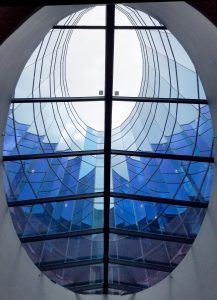
Most daylighting failures are not material failures or installation failures. They are decision failures made at schematic design — when the wrong daylighting strategy was committed to before anyone fully understood what the space actually needed. By the time construction documents are issued, the cost of changing direction is high. By the time the building is occupied, it is effectively permanent.
The good news is that the decision is not complicated when it is approached the right way. Skylights, canopies, and translucent wall systems each solve a specific daylighting problem. The framework below is the same one Crystal Structures uses with architects and owners during early-stage design collaboration — built from more than 40 years of commercial glazing work and over 26,000 completed projects across all 50 states. It is designed to land you on the right system at schematic, before the cost of the wrong answer compounds.
Start With the Question Daylighting Is Actually Solving
Before specifying any system, the project team has to answer one question: what is daylighting trying to accomplish in this space?
The answers fall into four buckets, and each one points toward a different system family:
- Architectural impact — daylight as a design feature visible to occupants and visitors
- Functional illumination — daylight as a working light source that reduces reliance on electric lighting
- Pedestrian experience — daylight at building entrances, walkways, or transition zones
- Visual connection to outdoors — clear views of sky, surroundings, or specific architectural elements
Most commercial buildings need more than one of these in different zones. The decision framework below works zone by zone — not building by building.
Decision Question 1 — Is the Daylight Going Through a Roof, a Wall, or Over an Outdoor Space?
This is the first sort, and it eliminates entire system categories immediately.
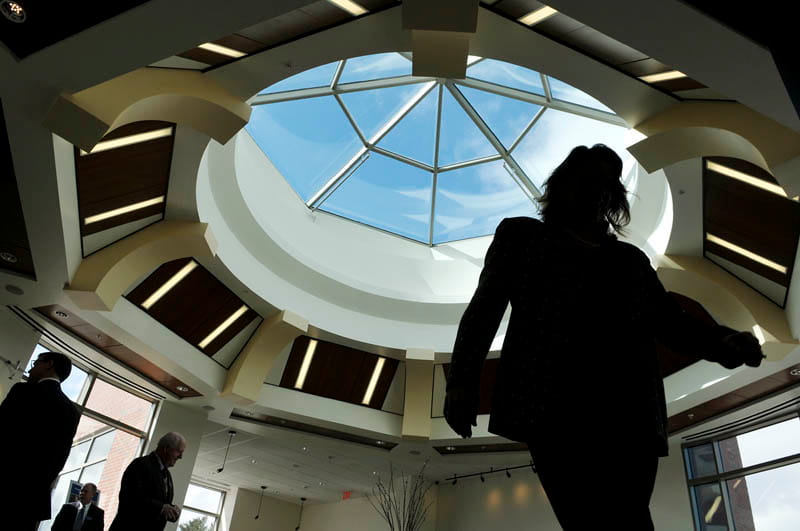
Roof openings point to skylights or translucent roof systems. The choice between the two depends on scale, geometry, and architectural intent (covered below).
Wall openings point to translucent wall systems, conventional glazing, or hybrid clerestory configurations. Translucent wall panels are the right answer when daylight is wanted but views, security, or thermal performance prevent traditional windows.
Outdoor pedestrian zones — entrances, walkways, transit drop-offs, plaza coverings — point to glazed canopy systems. These are not daylighting systems in the traditional sense, but they bring controlled overhead daylight to outdoor or semi-outdoor spaces and are often part of the broader daylighting strategy.
This first sort is usually obvious. The harder decisions come at the next level.
Decision Question 2 — How Big Is the Daylit Area?
Within roof openings specifically, scale dictates the right system.
Small to medium openings (under ~400 sq ft per opening), defined floor zones below. A unit skylight is usually the right answer. Pre-engineered, factory-built, predictable performance, fast installation. Available in ridgelite, single-slope, barrel vault, pyramid, and low-profile configurations to match design intent.
Large openings, broad floor coverage required. A non-structural translucent roof system — like Crystal Structures’ SkyQuest with the patented TearDuct™ Weepage Control System — delivers uniform diffused daylight across warehouses, manufacturing floors, gymnasiums, and other high-volume spaces. The 2¾-inch structural polycarbonate sandwich panel is engineered specifically for these large-area applications.
Large openings with significant span requirements and architectural intent. A structural skylight is the right answer — the framing carries the load, allowing the system to span large openings or take complex geometric forms (barrel vaults, pyramids, ridge configurations) without supplementary steel.
When in doubt, the rule is: defined opening over a defined space → unit skylight; large area over an operational floor → translucent roof; signature architectural feature → structural skylight.
Decision Question 3 — Do You Need Light, Views, or Both?
This is the question that separates translucent systems from clear glass.
Light only, no views needed. Translucent polycarbonate panels are almost always the right answer. They deliver diffused, glare-free daylight at lower material cost, lower weight, better thermal performance, and superior impact resistance compared to clear glass. Privacy is built in — light passes through, but sightlines do not. This is the right specification for warehouses, gymnasiums, locker rooms, restrooms, healthcare circulation zones, schools, and most industrial daylighting.
Views as part of the design intent. Traditional glass glazing is the right answer. Atriums, lobbies, retail showrooms, hospitality entrances, observation corridors, and any space where the visual connection to the outdoors is part of the experience. Glass delivers optical clarity that polycarbonate cannot replicate, and that premium is often justified for public-facing spaces.
Both, in different zones of the same building. Hybrid daylighting strategies — glass in public-facing signature zones, translucent panels over operational floors — are common on hospitals, schools, mixed-use developments, and corporate headquarters. Crystal Structures regularly engineers hybrid solutions that combine both system types within a single building envelope.
Decision Question 4 — How Will Glare and Heat Affect Space?
Some spaces tolerate direct sunlight. Most commercial spaces do not.
Sensitive to glare. Gymnasiums (players tracking balls), warehouses (forklift sightlines, picking accuracy), schools (whiteboards, screens), industrial floors (instrument readability), retail (merchandise display) — all of these benefit from translucent diffused light over clear glass. A bright spot from a clear skylight that moves across the floor through the day will create complaints and operational problems in any of these environments.
Sensitive to heat gain. Large-volume spaces with limited mechanical conditioning, climate-controlled retail with merchandise sensitivity, warehouses with HVAC cost concerns, and any building chasing energy targets benefit from translucent systems with built-in thermal performance over single-pane clear glass.
Tolerant of direct light and views. Atriums, lobbies, observation areas — clear glass is fine, especially with high-performance insulated glazing units that include low-E coatings.
The simple test: if anyone in the space will be tracking a moving object, reading a screen, or working under conditions where light contrast matters, translucent wins on the daylighting side of the decision.
Decision Question 5 — Is the Space Indoor, Outdoor, or Transitional?
Canopies enter the framework here.
Outdoor pedestrian zones. Building entrances, walkways between buildings, covered drop-offs, transit shelters, courtyard coverings — these are canopy applications. The question becomes glass canopy or polycarbonate canopy, which depends on architectural intent (glass for premium aesthetics, polycarbonate for span flexibility, lower cost, and curved profiles).
Transitional zones at building entrances. Entrance canopies serve both daylighting and weather protection at the threshold between outside and inside. A glass canopy keeps the entrance experience bright and welcoming. A polycarbonate canopy delivers diffused, glowing illumination that is forgiving across all sun angles.
Long covered walkways across campuses. Polycarbonate is usually the right answer — Crystal Structures’ Sunpal standing seam polycarbonate system supports panels up to 43 feet long, which minimizes seams and accelerates installation across long pedestrian corridors.
Canopies are not interchangeable with skylights. They solve a different problem in a different location. A complete daylighting strategy on a multi-building project usually includes both.
Decision Question 6 — What Is the Structural Reality of the Project?
Daylighting decisions are constrained by what the building’s structural system can support — especially on retrofit projects.
New construction with flexible structural design. Any of the daylighting strategies above are on the table. The decision is driven by program needs and architectural intent, not structural limits.
Retrofit with limited structural capacity. Polycarbonate’s lower weight (50 to 80 percent less than glass for equivalent coverage area) often makes translucent systems the only viable daylighting option without expensive structural reinforcement. This is one of the most common reasons translucent systems are specified on existing-building daylighting projects.
Retrofit with existing structural framing the daylighting must conform to. Non-structural skylight systems — designed to attach to existing aluminum, steel, or wood structural members — are the right fit. Crystal Structures’ SkyQuest non-structural system is engineered specifically for this scenario.
New construction with custom geometry or signature architectural intent. Structural skylights and structural canopies engineered as part of the building’s load path, not bolted on afterward.
A Schematic-Design Decision Framework
Pulling the questions above into a single sequence:
- What is daylight solving in this zone? (Architectural impact / functional illumination / pedestrian experience / outdoor connection)
- Where does the opening go? (Roof / wall / outdoor pedestrian space)
- How big is the daylit area? (Defined opening / broad coverage / signature span)
- Light only, views only, or both? (Translucent / clear glass / hybrid)
- How sensitive is the space to glare and heat gain? (Translucent / clear glass acceptable)
- What does structural reality allow? (Any system / weight-constrained / existing framing / custom geometry)
Run a multi-zone building through this framework once, and the daylighting strategy resolves itself: structural glass atrium in the lobby, translucent polycarbonate roof panels over the operations floor, unit skylights along corridors, translucent wall panels in clerestory zones, glazed canopies at entrances and connecting walkways. Each zone gets the system that fits it — not a single product type forced to do work it was not designed for.
Why Single-Source Daylighting Engineering Matters at Schematic
The framework above only delivers value if the same team that helps you make the decisions can also engineer, fabricate, and install whatever you choose. Otherwise, the schematic-stage strategy turns into a procurement exercise across multiple vendors who each optimize for their own product line.
Crystal Structures’ design team collaborates with architects and building owners at no upfront cost during schematic and design development — covering all four daylighting system families (skylights, translucent roofs, translucent walls, canopies) under a single engineering perspective. The same team then handles fabrication and installation across more than 25,000 completed projects nationwide, backed by a 10-year warranty covering materials, fabrication, and installation under one guarantee.
A daylighting strategy decided correctly at schematic, executed by a single accountable team, is the difference between a building that performs the way it was drawn and one that survives the gaps between vendors.
Working through daylighting decisions at schematic design? Contact Crystal Structures for a no-cost design collaboration with our engineering team.