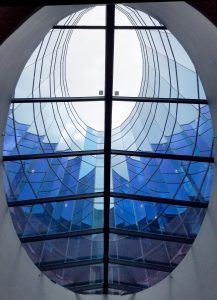
Commercial glass replacement looks like a simple transaction and rarely is. The glass in a curtain wall, storefront, skylight, or railing is part of an engineered assembly, and replacing one lite means matching a specification that may be twenty years old, working at height on an occupied building, and restoring performance the original design depended on.
Here’s how the process actually runs, and what governs the two questions everyone asks first.
The Process
1. Assessment. Before anything is ordered, someone identifies what’s actually there: monolithic or insulated, annealed, heat-strengthened or tempered, laminated or not, thickness, coating type and surface, tint, and the condition of the framing and gaskets around it. Establishing the failure mode matters too — impact, thermal stress, seal failure, spontaneous breakage, or a framing problem that will recur if only the glass is addressed.
2. Make it safe. A broken lite is a life-safety condition and a security opening. Temporary board-up or glazing stabilizes the building while the permanent unit is fabricated, which — as the next section explains — is rarely a same-week proposition.
3. Field measurement. Openings are measured on site, not scaled from drawings. Buildings move, frames deflect, and as-builts are optimistic. A unit fabricated to the drawing dimension and delivered to an opening that has settled is a wasted lead time.
4. Specification and match. The replacement has to match the original’s thickness, make-up, and appearance closely enough that it isn’t visible from the street. This is where schedules are won or lost.
5. Fabrication. Cutting, edge work, tempering or heat-strengthening, laminating, and insulated unit assembly — each step adding time depending on the make-up.
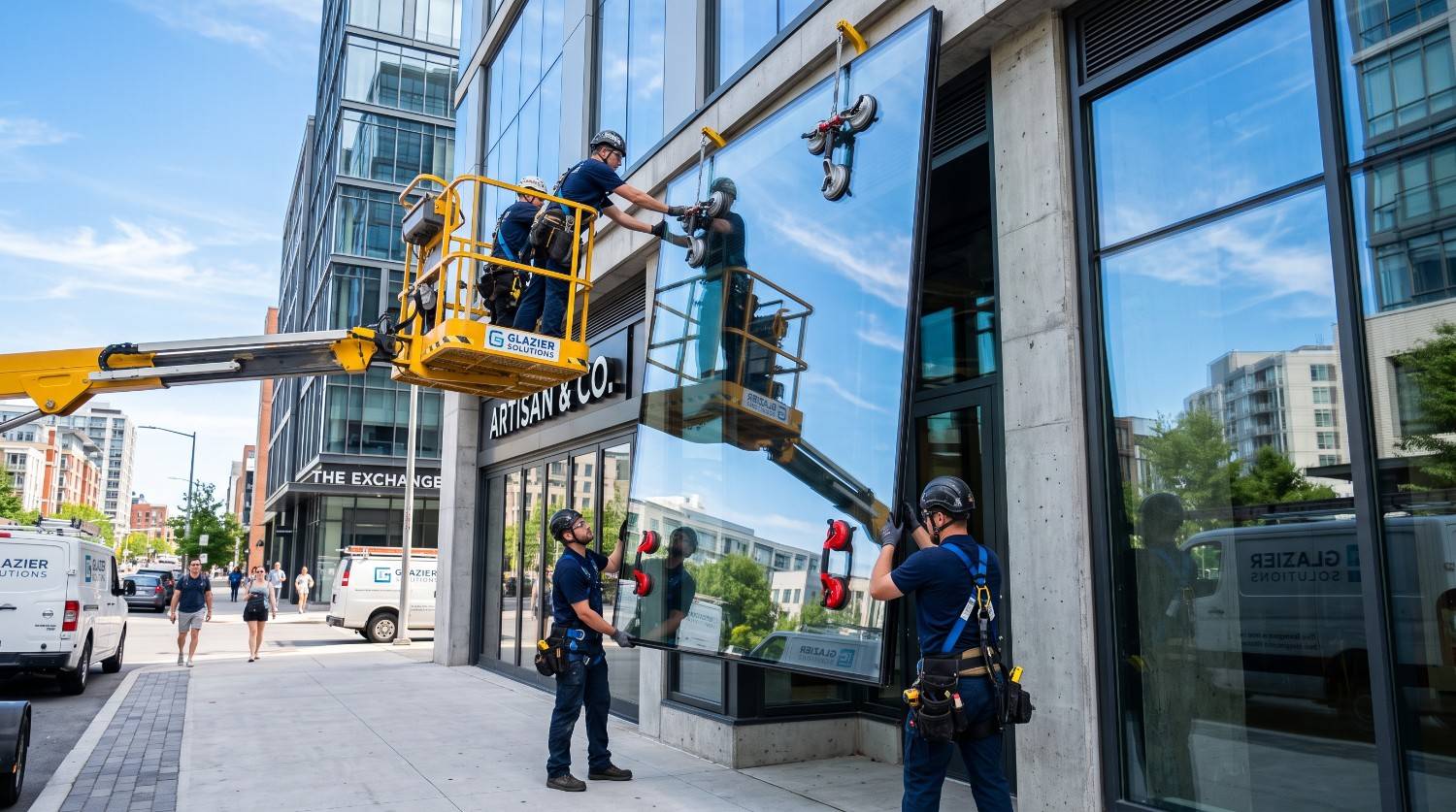
6. Installation. Access equipment, protection of the occupied space below and behind, glazing, sealing, and cleanup. On an occupied building this often means after-hours or phased work.
Lead Times
How Long Does Commercial Glass Replacement Take?
The glass make-up sets the floor, and coating availability sets the ceiling.
| Glass type | Relative lead time | What drives it |
| Annealed monolithic | Shortest | Cut from stock; minimal processing |
| Tempered | Short to moderate | Heat treatment cycle; no post-temper cutting possible |
| Laminated | Moderate | Interlayer assembly and autoclave cycle |
| Insulated glass unit | Longer | Component fabrication, then unit assembly and cure |
| Laminated insulated unit | Longer still | Both processes in sequence |
| Coated to match an older building | Variable — often the longest | Depends entirely on whether the coating is still produced |
| Curved, fire-rated, or oversize | Longest | Specialist fabrication, limited sources |
The practical consequence: a broken storefront lite in clear tempered glass is a fundamentally different schedule from a fogged insulated unit with a discontinued low-E coating on a 1990s curtain wall. Same phrase, same building, wildly different timelines.
Can You Match Existing Glass?
Usually, it’s the question that determines your schedule.
Coatings change. A low-E product specified in 2003 may have been reformulated, renamed, or discontinued, and its closest current equivalent may differ subtly in reflectance or tint. On a single lit in a large elevation, subtle is enough to be visible from the sidewalk.
Options when an exact match isn’t available: source remaining stock of the original, use the nearest current equivalent and accept a slight variation, or — on a highly visible elevation — replace a larger area so the difference falls at a natural break rather than mid-facade. The third is more expensive and sometimes the only acceptable answer aesthetically.
The lesson for facilities teams is worth stating plainly: record the glass specification while you still have it. A building that knows its original make-up replaces glass in weeks. One that doesn’t spend the first stretch identifying it.
Costs
What Does Commercial Glass Replacement Cost?
Wide range, and access is often the larger half.
Publishing a per-square-foot figure would be misleading, because the same lite can vary by a large multiple depending on conditions. What’s stable is the list of drivers:
- Glass make-up — roughly ascending: annealed, tempered, laminated, insulated, laminated insulated, fire-rated, curved
- Size and weight — past a threshold, installation shifts from hand-set to mechanical lifting, which changes crew, equipment, and duration
- Access — a ground-floor storefront and a twelfth-floor curtain wall lite are the same glass and different projects; swing stages, boom lifts, cranes, street closures, and permits add up quickly
- Occupancy — after-hours work, phasing around tenants, and interior protection all carry cost
- Framing condition — if gaskets, pressure plates, or the frame itself are damaged, scope grows beyond the glass
- Urgency — emergency response and expedited fabrication carry premiums
- Quantity — one lite carries full mobilization; a whole elevation spreads it
The counterintuitive one is that on high-rise work, the glass itself is frequently a minority of the invoice.
Does the Frame Have to Be Replaced Too?
Often not, and the assessment should tell you before anything is ordered.
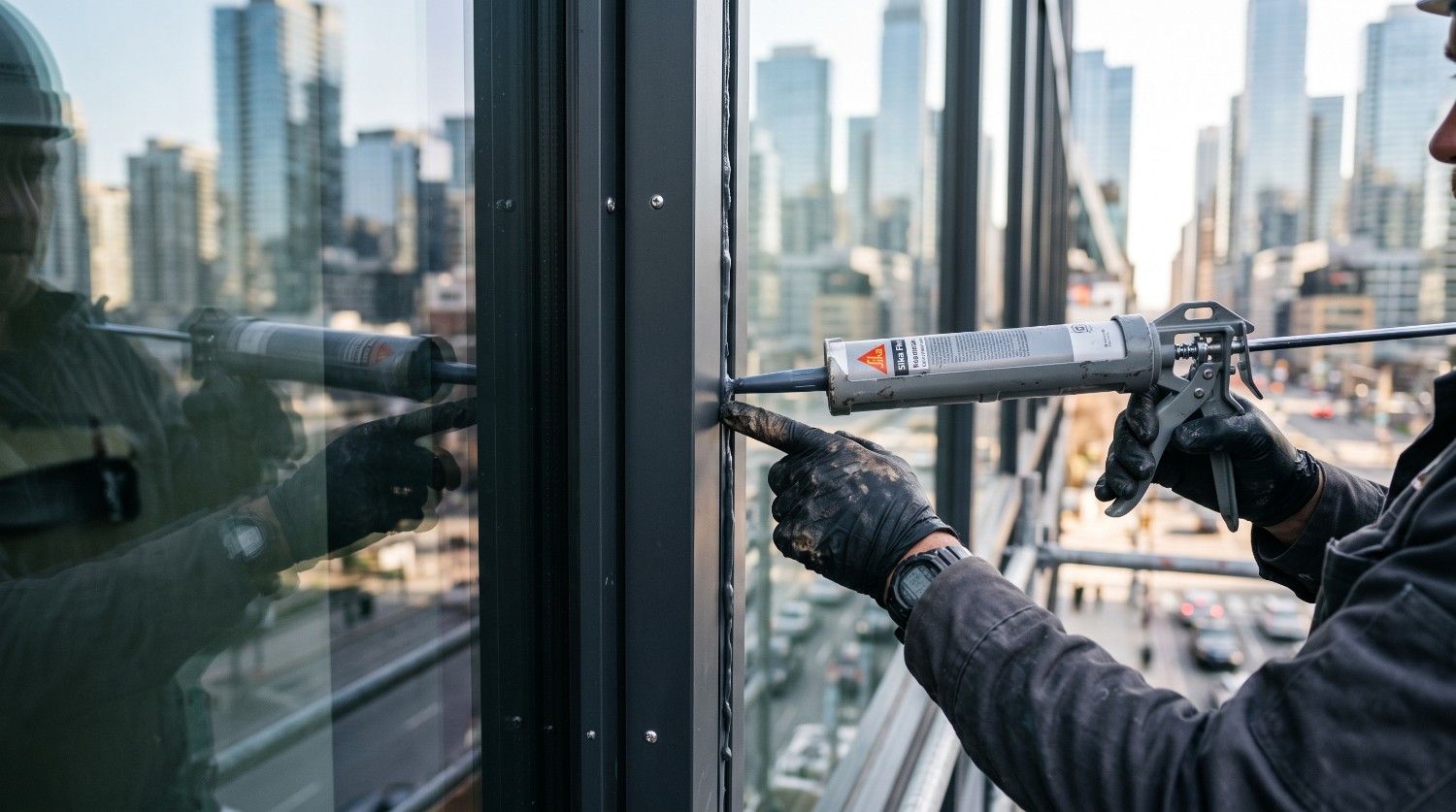
Aluminum framing commonly outlasts several generations of glass. If the frame is sound and the gaskets are serviceable, glass replacement is exactly that. But gaskets harden and shrink, pressure plates corrode, thermal breaks degrade, and drainage weeps block — and installing a new unit into compromised framing reproduces the original failure on a delay.
A proper assessment covers the framing, not just the opening.
Does Replacing Glass Trigger a Code Upgrade?
Sometimes, and it’s worth checking before the order goes in rather than at inspection.
Codes change, and a lite installed decades ago may not satisfy current requirements for its location. Glazing in hazardous locations — door sidelites, panels close to floor level, wet areas around pools and locker rooms, guards and railings — carries safety glazing requirements that have tightened over time. An original annealed lite in one of those positions generally has to come back as tempered or laminated, regardless of what was there before.
Energy code can apply too. Replacing a significant portion of an elevation may bring the work within the scope of current performance requirements rather than being treated as like-for-like repair. Jurisdictions differ substantially on where that threshold sits.
None of this is difficult to accommodate when it’s identified during assessment. It becomes expensive when a fabricated unit arrives and can’t be installed.
The Insulated Unit Question
Why Is My Window Foggy, and Can It Be Repaired?
The seal has failed, and no — not properly.
An insulated glass unit is two or more lites separated by a spacer, sealed at the perimeter, with dry air or argon between them. When that perimeter seal fails, moist air enters, condenses on the inner surfaces, and leaves the mineral deposits that produce permanent haze. Thermal performance drops with the lost fill gas.
Services exist that drill, vent, and dry these units. They clear the visible fog and do not restore the seal, the gas fill, or the thermal performance — the unit remains breached and continues to cycle moisture. On a commercial building with an energy performance target, that’s a cosmetic fix to a performance failure.
The correct answer is unit replacement. Which is also why fogging across multiple units on the same elevation is worth investigating as a pattern rather than a series of coincidences — clustered seal failures usually point to drainage, glazing pressure, or thermal cycling in the framing.
Working With a Single Source
Crystal Structures handles contract glazing — storefronts, curtain wall, glass railing, and point-supported systems — alongside skylight repair on overhead and sloped assemblies, with fabrication in-house rather than brokered through a third party.
That matters most on the assessment: diagnosing whether a fogged unit is an isolated seal failure or a symptom of a drainage problem, and whether the framing will support the new glass, is the difference between replacing a lite once and replacing it twice.
Planning a glass replacement where matching, access, and schedule all have to line up? Contact Crystal Structures for a no-cost design collaboration with our engineering team.