Storefront glass is the part of a building that gets hit — by vehicles, weather, shopping carts, and occasionally people. It’s also the part tenants notice immediately and customers judge instantly.
This is the practical version: what to do in the first hour, how to decide between repair and replacement, what actually drives the schedule, and which twenty minutes of annual maintenance prevent most of the calls.

The First Hour
What Should I Do First When Storefront Glass Breaks?
In order:
Secure the area first. Cordon it off inside and out. Tempered glass fails into small fragments, but a partially broken lite still in the frame can release without warning.
Photograph everything before cleanup. Wide and close shots, the frame as well as the glass, plus anything indicating cause. Insurers ask, and a glazier quoting from photographs quotes more accurately. Once someone sweeps up, that record is gone.
Check whether the opening is secure. A ground-floor opening overnight is a security problem regardless of what’s in the store. If the frame is intact and only glass is gone, temporary infill closes it quickly.
Look for the stamp. Tempered glass carries an etched mark in a corner naming the fabricator and standard. If a fragment or the adjacent lite still shows it, photograph it — it tells the glazier what to order and can save a site visit.
Then call. Not before the photographs.
Know your temporary options in advance. Plywood is fast, secure, and tells every passer-by the business had an incident. Clear polycarbonate infill costs more, goes in nearly as fast, and lets the store trade normally while the permanent lite is fabricated. For a retail tenant, that difference often exceeds the cost.
Repair or Replace
Can Cracked Storefront Glass Be Repaired?
No — and the reason matters.
Storefront glazing sits in what codes call a hazardous location, meaning it must be safety glazing: tempered or laminated. Both are engineered to fail in a controlled way, and both depend on being intact to do it. A crack, an edge chip, or a nick in a tempered lite compromises the stress pattern the panel relies on. It gets replaced before it fails on its own schedule.
Windscreen-style resin injection doesn’t transfer to architectural glazing.
What can often be repaired is everything around the glass.
| Symptom | Likely cause | Typical resolution | Urgency |
| Cracked or chipped lite | Impact, thermal stress, edge damage | Replace the lite | High — it will fail further |
| Fogging or haze between panes | Insulated unit seal failure | Replace the unit; frame stays | Low — cosmetic and performance, not safety |
| Door drags, won’t latch | Closer, pivot, or hinge wear; racked frame | Adjust or replace hardware | Medium — becomes a security issue |
| Door slams or won’t close fully | Closer out of adjustment or failed | Adjust or replace closer | Medium |
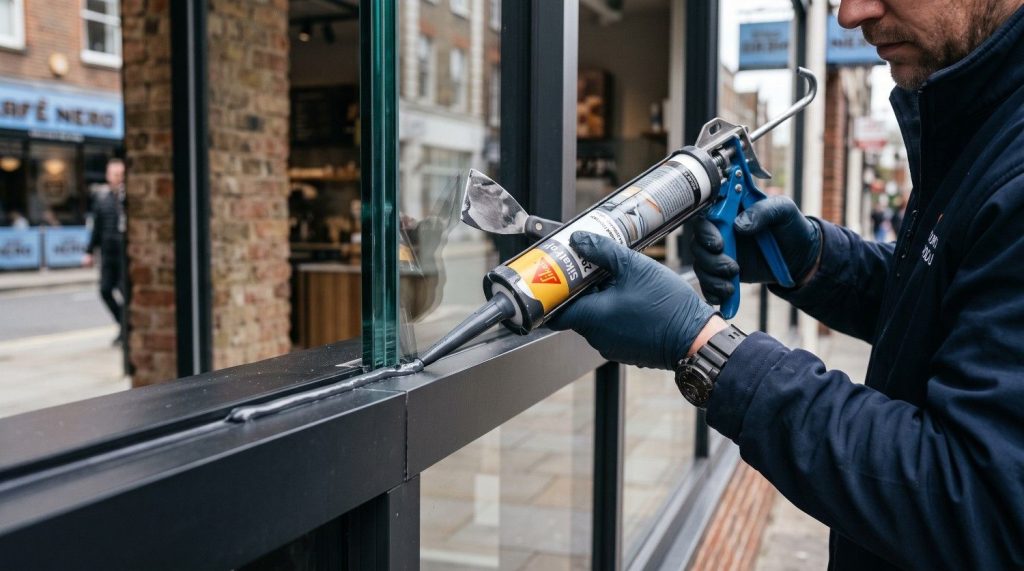
| Water at the sill inside | Blocked weeps or failed sealant joint | Clear weeps; reseal | Medium — causes secondary damage |
| Bent or deformed framing | Vehicle impact | Replace the affected section only | High if structural |
| Draughts, whistling | Perished weatherstrip or gaskets | Replace seals | Low |
The pattern worth internalising: glass gets replaced, hardware gets serviced, framing gets sectioned. A vehicle strike rarely means replacing an entire elevation — damaged members can usually be cut out and replaced in kind.
Why Won’t My Storefront Door Close Properly?
Because the closer, the pivots, or the frame geometry has shifted — and this is the single most common storefront service call, ahead of glass.
Entrance doors cycle thousands of times a year. Closers lose fluid and fall out of adjustment, pivots wear and let the door drop onto the threshold, and frames rack slightly under repeated impact or building movement.
Most of it is adjustment rather than replacement, and most of it is cheap when caught early and expensive when ignored — a dragging door wears its own hardware faster, and a door that won’t latch is an unsecured building.
Lead Times and Scheduling
How Long Does Storefront Glass Replacement Take?
Clear tempered days. Anything else is longer, and the difference is entirely about the glass.
Quarter-inch clear tempered in a standard size is the fastest thing in commercial glazing. From there the replacement schedule extends with each variable: insulated units need assembly after their components are made, Low-E coatings have to match what’s already in the elevation, tints and laminated make-ups add processing, and oversize lites narrow the field of fabricators.
Two practical consequences for facility managers.
First, temporary infill is not a failure of urgency — it’s the normal state of a correctly managed repair. Anyone promising a same-day permanent insulated unit is either substituting a different make-up or hasn’t looked at it yet.
Second, and more useful: keep a record of your glazing specification. Glass type, thickness, make-up, coating, and tint for each elevation. A building that knows its own spec orders on day one. A building that doesn’t spends the first stretch working out what’s there — which on a multi-tenant property with phased fit-outs can mean several different make-ups in one facade.
Preventing the Next Call
How Do I Stop Water Coming In at the Storefront Sill?
Clear the weep holes. It’s the highest-return maintenance task on the entire system.
Storefront framing is designed to drain internally: water that gets past the exterior gaskets is collected in the sill and discharged through small weep openings along the bottom. Those openings block with dirt, landscaping debris, insect nests, and — regularly — sealant applied by someone trying to stop a draught. Once blocked, the sill fills and water goes inward, which reads as a leak and gets “solved” by caulking over the weeps, making it considerably worse.
Checking and clearing them takes minutes per elevation and prevents most storefront water intrusion.
Worth adding to an annual walk-through:
- Door hardware — closer adjustment, pivot wear, threshold condition, latching
- Sealant joints — perimeter and at transitions to adjacent construction
- Gaskets and weatherstrip — hardening, shrinkage, gaps at corners
- Glass condition — edge chips, early fogging, stress cracks starting at edges
- Bollards — at any elevation exposed to vehicle traffic, they cost a fraction of a frame replacement
And one specification point that protects you: when glass is replaced, confirm it’s going back as safety glazing. Storefront positions require tempered or laminated. A contractor substituting annealed glass to save cost or time creates a code violation and a liability that lands on the building, not the installer.
Who Is Responsible — Landlord or Tenant?
The lease decides, and it’s worth knowing the answer before something breaks rather than during.
Commercial leases split envelope responsibility in very different ways. Some treat storefront glazing as landlord structure; others assign it to the tenant, particularly where the tenant installed the fit-out. Entrance door hardware is often carved out separately, since it’s a wear item rather than a building element.
For a multi-tenant property, the practical step is a single sheet recording, per unit: who owns the glass, who owns the door hardware, who carries the insurance, and who holds the deductible. Assembling that during a break — with a boarded opening, a closed tenant, and an insurer asking questions — is how repairs get delayed for reasons unrelated to glass.
It also affects specification. Where a tenant funds a replacement, a cheaper make-up often goes in than the elevation originally carried, showing up later as a visible mismatch. Approval should sit with whoever owns the building’s appearance, whatever the lease says about who pays.

Getting It Fixed Once
Crystal Structures handles contract glazing — storefronts, curtain wall, glass railing, and point-supported systems — with fabrication in-house rather than brokered.
For facility managers the useful part is diagnostic. Whether recurring fogging on one elevation is coincidence or a drainage problem, and whether a racked door is hardware or frame movement, determines whether a repair holds. That’s the difference between fixing it once and fixing it annually.
Managing storefront glazing where security, tenant impact, and schedule all matter at once? Contact Crystal Structures for a no-cost assessment with our team.